Sunday, October 13, 2013

Mr. Manners Meets Goofus And Gallant

Eustace Tilley, from The New Yorker
Gentle Photographer: 

Recent events made it imperative that Mr. Manners speak his mind concerning observations that have caused me great distress. I am speaking about behavior I would consider most inappropriate when one is engaged in recreational, professional, or semi-professional photographic endeavors. But I digress.

When you're in the field, remember that you can't make a photograph unless you have a subject to photograph. If you work with people as much as I do, you will definitely need your subject's cooperation if you're going to get what you came for. A recent assignment reminded me about how we, as photographers, should present ourselves in public. There are a number of things I routinely do that ultimately make my job easier, things that are easily overlooked.
  • Dress Appropriately: I never wore a suit to an assignment, nor have I worn shorts and a T-Shirt to an indoor assignment. I have found chinos, penny loafers,  and a black polo shirt adequate for nearly all of the events I have photographed.  
  • Introduce Yourself: I make it a habit to introduce myself to anyone who looks responsible, and especially to those who are wearing name tags or carrying walkie-talkies. I do this so that I am recognized as a media photographer by as many people as possible.
  • Explain What You Are Doing: When I get past "security" and am introduced to the publicist (or someone serving in that capacity), I try to explain what I am looking for in a photo. Remember that this person may be directly accountable for everything that happens during the event, and would be justifiably uneasy when there is a photographer wondering about, looking for random photos to shoot. 
  • Talk To Your Subjects: It's much easier to get your subjects to cooperate when they know what you're doing, and why. If you see something interesting, introduce yourself and explain why you want to make the photograph. 
  • Refrain From Eating and Drinking: Many events may have a snack spread out for the invited guests, and I have sometimes been told to "help myself".  My pat answer is "No, but thank you your thoughtfulness", simply because the person making the offer may not, in fact, be authorized to do so. There is also the potential, however slight, that somebody will see me eating and assume that I just decided to "help myself". 
  • Make Yourself As Small As Possible: I go to great lengths to not interfere with the guests and their activities. Stay out of the way as much as you can. This includes keeping your equipment bag out of the main stream so people don't have to walk around it, or worse, fall over it.
  • Replace Anything You Move: If you move it, commit yourself to returning it to its original location. I have occasionally rearranged furniture when photographing groups of ten or more subjects. But I make sure that I replace everything immediately after the image is made. Always assume that everyone is watching, and that somebody will remember you unfavorably if you don't clean up after yourself.
  • "Thank you, I had a wonderful time, this was the easiest photo assignment I ever had, and I'll probably win a Pulitzer Prize for the photos I made today. You really helped make this my easiest assignment ever...": Is this pretty clear, or do I need to explain further? However small their contribution, let the right people know you appreciate what they did.

http://ourprerogative.wordpress.com/2008/11/07/fun-with-a-purpose/
Goofus With A Camera:
Remember Goofus and Gallant? They were (or are, for all I know) a regular feature in Highlights, a magazine that could only be found in doctor's offices, or so it seemed. Basically, G & G was an ongoing confrontation of social values featuring two young boys facing an identical social dilemma. Goofus always takes the easy way out, never thinking about the impact of his actions on others. Gallant, on the other hand, always takes the high road. Consider him the the male counterpart of Shirley Temple. 


My takeoff on this "bad kid, good kid" format resulted from an encounter with a photographer during one of my assignments for the San Mateo Daily Journal. I was sent to make a photograph that would illustrate the essence of a charity tour of a recently renovated Hillsborough estate which was opened exclusively for this event.
  • Goofus comes to the estate and assumes that he is free to photograph whatever and wherever he chooses. 
  • Gallant checks with the publicist to see if there are any restricted areas, and any subjects that should not be photographed.Restrictions on photography are not uncommon whenever historical locations are opened to the public.
  • Goofus opens up a tripod and puts in on the Italian amber marble floor, denying other guests access to the room where he's photographing and risking scratches to the floor and scuffs to the furniture.
  • Gallant doesn't use a tripod unless it has been cleared by the publicist well in advance, and then only on a "closed set" with no foot traffic. If permission is given, Gallant makes sure that his tripod does not leave any marks, especially when the floor is Italian amber marble, and is particularly careful when moving to prevent accidental damage to the surroundings.If he must put his equipment bag down, it will be out of the way, and preferably on a carpet or rug to eliminate the possibility of scuffing the floor.
  • Goofus directs his wife to sit on a decorative antique sofa so he can make a photograph of her.
  • Gallant never poses his subjects on furniture that might be more decorative than functional, especially in a private estate where public access is restricted. Instead, his subjects are pictured standing beside the furniture with pleased expressions on their faces.
  • Goofus uses direct, on-camera flash.
  • Gallant uses soft bounced light, and never uses an on-camera key light unless there is no other way to make a photo. He may use it as a fill, but very sparingly.
  • Goofus uses Canon equipment.
  • Gallant uses Nikon equipment.Heh heh.
  • Goofus uses the self timer and then  leaps to his wife's side on the decorative antique sofa so they can be photographed beside one another.
  • Gallant drops his jaw in disbelief.
  • Goofus is told in no uncertain terms that he must immediately stop making photographs.
  • Gallant continues shooting, finishing the shot in less than two minutes.
  • Goofus, without a trace of contrition, returns to ask Gallant why he gets to continue taking pictures.
  • Gallant replies "I'm with the press, and I was invited".
  • Goofus disappears into the crowd and is not seen again.
  • Gallant, his photo 'in the can", packs up his equipment and prepares to leave, wearing his smile of simian satisfaction.
While my secondary rant was aimed at his behavior, it can serve as a reminder of how we should behave when working on location.  All kidding aside, photographers should consider how their actions appear to others. Even though you may be invited, you are not a guest. And while you may not be paid for your services, you should still present yourself as a professional. And finally, always present your best work. When you adopt the "Why bother? I'm not getting paid for this" attitude, you will miss opportunities to demonstrate how capable your really are. If you allow yourself to be governed by how much (or how little) you were paid, many will assume your unwillingness to produce a quality product comes from your inability to create one.

Sunday, October 6, 2013

Podium Shots

Photo #1

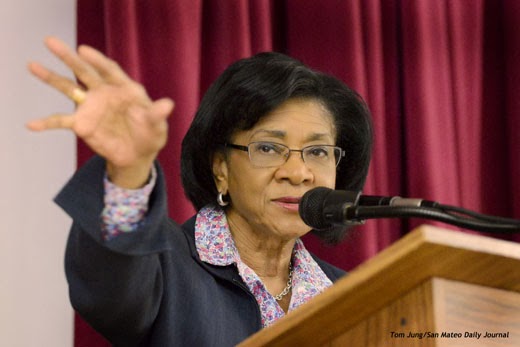
I recently made this photo of Belva Davis, a true pioneer in Bay Area journalism. I am an unabashed fan of her work, and religiously watched her Friday "This Week In Northern California" on local public television. I always enjoyed listening to her speak, and thought it a special treat when she was one of the speakers at an event I was covering for the Journal. Let's get the technical stuff out of the way: The camera was a Nikon D7000, 70-200 2.8 Nikkor, 1/160 of a second at F 3.2, ISO 6400 equivalent. It took me over 150 shots, nearly a full card, to get an image that I was pleased with.

I make a lot of podium shots. Politicians, Motivational Speakers, Authors, I've done them all. Sometimes you'll find a real gem, a man or woman with a perfect smile, a good stage presence, and the wherewithal to pause occasionally and look up from his or her notes. But just as often, your subject will be the exact opposite. Podiums are a true gift because you don't always get exactly what you want. You just say, "Thank you", and move on.

I actually enjoy shooting podiums, as the offer challenges to both composition, and timing. Aside from the obvious, here are some things you'll need to consider.

Lighting: I seldom encounter a situation where the lighting was arranged by a real lighting professional, so white balance settings are "close" at best, and position haphazard at worst. If one is lucky, the Incandescent white balance preset will work well, or well enough to adjust properly in post production. Assuming that aspect is under control, I move on to other aspects of the photo.

Shooting Position: I prefer to photograph speakers from the subject's left side. I find that a photo will have greater impact if the subject faces the viewers left. Since viewers usually read from left to right, they will visually scan the image in the same manner and will meet  the subject's gaze "head on". A minor point to be sure, but one that gives the image some additional impact. 

Background: I usually don't get to stand up for these shots unless I am very far away. Most of these shots were taken while kneeling on the floor, close to the stage. I try to stay at least ten feet away and rely on a relatively long zoom lens to get these tight shots. The low shooting angle can sometimes work to your advantage, since you can include large portions of the background to add context to the photo. When I can, I move to a position where the background adds to the informational value of the photo.

Hands: The hands often add some action to the image, and I watch how the speaker uses them. You can usually get an idea of a person's speaking style in the first few minutes. In all these samples, the hands add visual interest to the photo, and because they are usually away from the body, they are more easily seen. If the subject is right handed, the gesture won't be lost against the body. Also, try to NOT cut any finger tips off!

Mouth: In the image of Ms. Davis (Photo #1), the edge of the mouth is clipped slightly. It is not unusual for the microphone to cut into some part of the subject's face, so be careful. Sometimes the upper lip will cast a shadow on the subject's teeth. To avoid this, wait until they are looking into the light before you shoot.

Eyes: Avoid cutting off the far eye. Either get both eyes, or just the near one. Shadows caused by deeply set eyes can also be a problem. Again, wait until they are looking up before you shoot. This can be difficult because many speakers never seem to look up from their notes.

Photo #2
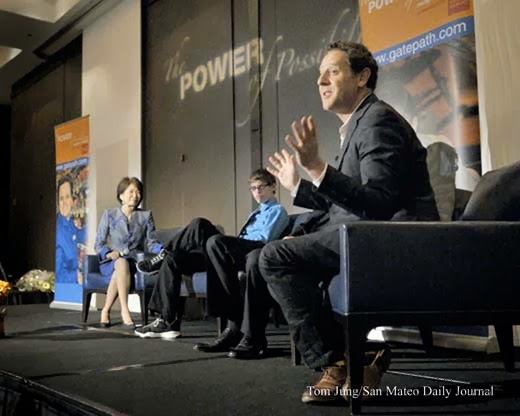
Photo #2 was made during a presentation by an independent film director who was discussing his recent film. The event was a fund-raising luncheon titled "The Power Of Possibilities". I made it a point of shooting with a wide angle lens from a low angle to include as much of the background as possible. Without the background, the image has no context. The rather harsh stage lighting was from the left, and the main subject faces directly into it. The hands are clearly delineated from the dark background, and the open fingers add some visual interest. Notice the single eye.

Photo #3
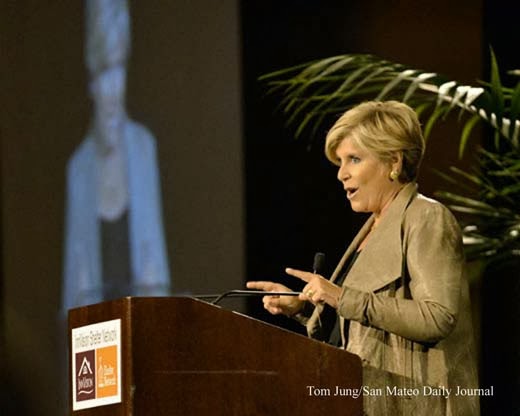
Photo #3 is a well-known motivational speaker. I was some distance from the podium and use a long lens to bring the background forward. Had there been more light I may have been able to use a smaller aperture to bring the projected image into clearer focus. Incidentally, the mixed light sources (incandescent for the speaker, "daylight" from the digital projector) give the image an odd look. However, the logo for the luncheon's hosts is clearly visible. The hands are well placed, clearly visible against the darker background, and in a forceful pose. Incidentally, this was the only shot where this "pointing" gesture was captured. Again, we have a photo that shows only one eye. One bit of advise: If you must color correct in post processing, make sure the skin tones are as natural as you can make them. The viewer can accept a surprising degree of discoloration so long as the skin tones are relatively true, or in the case, a tad on the warm side.

Photo #4
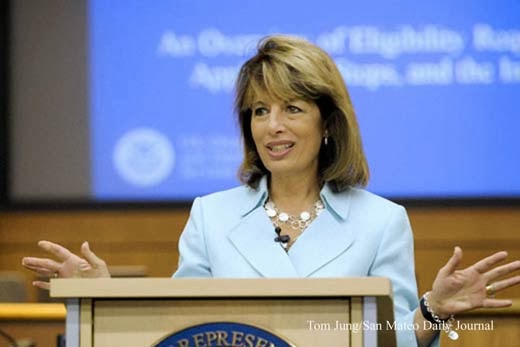
In Photo #4, the background helps to define the environment, just as it did in Photo #2. Again photographing from the subject's left, her eyes are focused on the audience, and her hands are clearly visible, separated as they are from the out-of-focus background. This open hand gesture adds to the impression that the speaker is ready to listen to input from the audience, which is precisely her intent. I probably could have increased the depth of field by shooting with a smaller aperture, but that would required an excessively long exposure time. When shooting indoors, you also risk the chance of subject movement, something Vibration Reduction won't prevent.

Photo #5
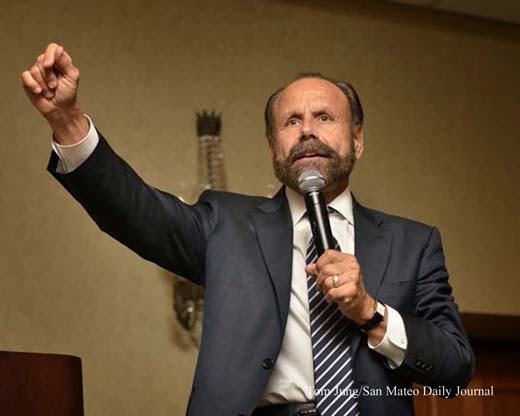
Photo #5 has all of the qualities of a good podium shot, in spite of the fact that the subject is standing in the middle of the room. All of the important facial features are clearly visible, and there is just a hint of teeth showing when he speaks. The arm is held up and away from the body, and his raised hand appears natural. Incidentally, this shot was taken with an on-camera flash aimed at the ceiling with a shield to prevent direct light from spilling onto his face. Shooting from a low angle eliminates most of the ground clutter, giving a clean image. The image was not submitted because the subject was not the keynote speaker.

Photo #6
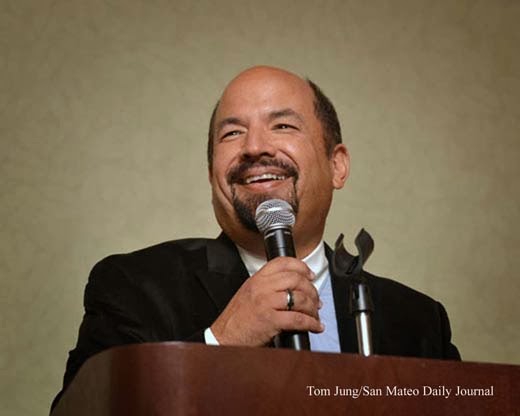
Photo #6 is not particularly animated, but shows off the subject's winning smile. There is plenty of light on his teeth, and the microphone is held away from the mouth. As with Photo #5, bounce flash was used, and the shot made when the subject looked up. The background is completely without detail, but this might do as a photo for an article about him. This photo was not submitted, but included as an example of a technically good shot with little editorial value.

All of the images in this collection have some common qualities. They have animated poses, good detail and proper treatment of the hands and eyes. But remember that these images were chosen from dozens of potential candidates, many of which differed only slightly from the one that I ultimately submitted. You can't predict when you'll make the winning shot, but you can learn to recognize it when you're at your computer, reviewing the day's take.


Addendum: You may wonder why certain images, particularly Photos #2 and #4, while properly exposed, lack a degree of color accuracy. They were made using the light that was available. This is often a mish-mash of of incandescent and fluorescent light sources, a mixture that is results in a less than ideal color rendition. I was not able to take a white balance reading at the podium, so I chose one of the white balance presets, crossed my fingers, and hoped that I could correct it in post processing. Photos #5 and #6 were on-camera speedlight ceiling bounce, which explains the color accuracy of the image and soft quality of the light. Photo #1 was shot with north light from a bank of windows to the subject's right.