|
| Photo #1 |
Working
the Harley Owners Group (HOG) Toy Drive was my second Fuji affair, although the
camera’s limitations would become a serious shortcoming. First off, there was the
slow synchronization speed (1/180 second). Second, the Fuji’s focusing speed is somewhat slower than a DSLR. But again, the lack of weight of my full kit
overruled these performance concerns.
 |
| Photo #2 |
Over the years, I submitted a variety of shots for this holiday event without resorting to a picket fence shot. One year, I submitted a shot of a Santa-capped award recipient being honored by his fellow HOGs (Photo #2). And once, I actually submitted a shot showing a “Hog” member
with a young child (Photo #3), but only after I spoke at length with her
Grandmother. She had just received a brand new Hello Kitty backpack filled with school supplies, a gift from the HOGs.
 |
| Photo #3 |
As I mentioned in several earlier posts, photographing young children requires more care. Your child subject may be involved in a custody battle, where any publicity could have some serious consequences. Always, ALWAYS get permission from a parent or guardian before submitting a shot like this, especially when the subject is so easily recognizable, as this happy young lady was in this shot.
Since so many of my earlier efforts had been made indoors, I wanted to try to get something outside, perhaps with a great sky and some fleecy clouds in the background. Here's where the Fuji's shortcomings began to show up. First off, the maximum flash exposure speed was 1/160th of a second. If I wanted any detail in the sky, I'd need an aperture setting of F16, with an ISO of 200. This is very close to the Sunny Sixteen setting often prescribed in the pre-light meter days. Pushing against that tiny aperture, my flash would need full output at every shot even when used at distances between 7 to 10 feet.
 |
| Photo #4 |
 |
| B&H Photo |
The flash was held at arm's length overhead, and as an experiment, triggered wirelessly using a Wein Sync-Link. This little gizmo would blow a "wink" of infrared light toward the subject, which was detected by the forward-facing optical trigger on my Younguo 560 with surprising consistency. I can't say it was 100% reliable, since the flash often failed to fire when it hadn't reached full charge, something resulting from a lot of shooting done in a short period of time, which obviously something that can't be blamed on the Wein.
The beam spread of the flash was narrowed a bit, and aimed to the left to favor the closer subjects. The system worked reasonably well, except for the fireball reflection from the flash in the mirror in the foreground (Photo #4). We'll, at least I knew that if I maintained a constant distance from my subjects, my exposures would be pretty consistent.
 |
| Photo #5 |
When young Alex stepped up to the join the others, I knew I had the shot. Placing myself squarely in front of him, I started shooting (Photo #5). Granted, this was a pretty ugly looking box, but the shot served to confirm that my exposure was in the ball park. Now I had to wait for something visually interesting.
You can see some of the dangers of "choking up" on the beam angle. There is some definite light fall-off on the lower half of the box, something that I wish I could have avoided. But there wasn't time to worry, so I kept shooting, waiting for something more interesting.
 |
| Photo #6 |
This shot had some promise (Photo #6), but with everybody looking camera right, the shot fell apart. Again, just keep shooting!
In the end, I settled on the lead shot (Photo #1), as it had most of the visual elements I needed. The shot isn't perfect: There's some light fall-off at the lower edge, and Alex's face is a bit overexposed for my taste. But this final effort did have my blue sky, and lots of details in the shadows without any blown highlights. It would have been nice if more Hogs faced forward so that their jackets could lend some context to the shot.
In retrospect, this two-day experiment pointed out limitations of the the Fuji, insofor as working with flash is concerned. The low flash synchronization speed is a major handicap when trying to face down a subject partially illuminated by hard daylight. I'm not going to discard my mirrorless system any time soon, but will need to think long and hard about how to address the Fuji's shortcomings. Granted, a conventional DSLR would have faced the same problems, but the capabilities of, say, the Nikon iTTL system gives the shooter flash flexibility that the Fuji will never touch. Granted, I don't fit the Fuji user profile, which is to say that I'm not emotionally tied to the rangefinder form factor of the Leica years. The placement of the controls were copied from an analog archetype, where form may not have followed function, but instead was dictated by the engineer limitations of the time.
I have to remind myself that Fuji did create the X100 camera with a leaf shutter that could have provided the synchronization flexibility of my beloved Nikon D70s, and my own copy remains relatively unused. I might be better off replacing one of the X-E1 bodies with the X100, but that must wait for another time.

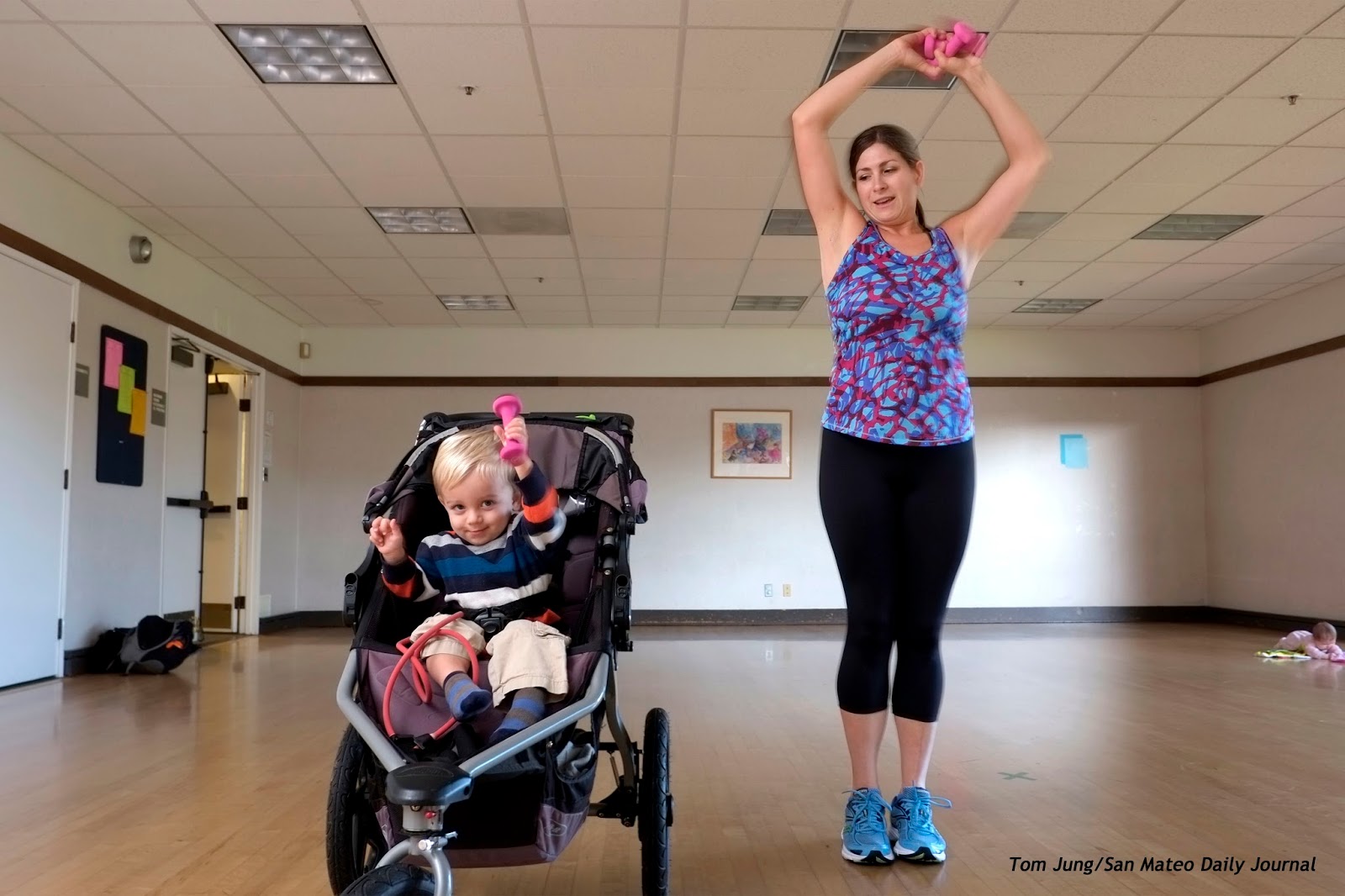
I had two assignments to complete as a particularly tenacious flu infection just started to wind down. I had committed to shooting them, and didn’t want to disappoint either of the organizations involved. One was a promotional shot for a Mommy-Baby class that used strollers as a substitute for a ballet barre. The other was a charity toy run which I’ve routinely covered since I started with the Journal.
Since I was in my recovery mode, I decided to adopt a minimalist approach so far as equipment was concerned. My reduced kit included 2 Fuji X-E1 bodies, a 35m F1.4, an 18mm F2, and a 60 F2.4 Macro which would double as a short telephoto lens. A Fuji EF-42 flash is stuffed somewhere, sometimes in a pocket or secondary pouch. A notepad and pen, and a single spare battery for the Fuji complete the outfit.
My first assignment would be photographed in an open exercise room with a low ceiling and white walls, an ideal bounce flash environment. For this, I brought a Yongnuo 560 flash with a supplementary 8-AA cell battery pack. Mounted in the hot-shoe of my 18mm equipped X-E1, proper exposures was obtained at full power, giving an even lighting that would reproduce well. A number of factors began to work in my favor. First, the north-facing windows allowed skylight to reflect off of the hardwood floors, creating some interesting visuals to the image. Exposure required some unusually long exposure times (1/15, F 4.5, ISO 200), but the low level of ambient light allowed the brief light burst of the flash to freeze most of the foreground at about 1/1000 of a second, giving me images that were sharp except for some edge blurring created by subject movement.
In this up close composite, you can see just how much the bounce flash adds to the photo. The darker image on the left was the result of shooting without the benefit of a fully charged flash. This pair reminds me that even with the supplementary battery pack, recycle time will be an issue, especially when changes in expression are fleeting, and frequent.
The viewing options provided by the mirrorless Fuji X-E1 gave me access to perspectives that would have been difficult to achieve if I was limited only eye-level viewing. Several of the shots were made from a nearly ground level perspective, using the LCD panel in the back of the body to refine composition. But the down side of this bounce-flashing from a low angle is how often I flashed myself in the face, something that should be avoided.
In the end, the lead shot was chosen. It had a number of key elements:
- Engaged Child In The Foreground: Beasts, babes, babies, and blood make for engaging photos, and a young boy, “exercising" with his mother, adds both to the subliminal context and visual appeal. The convergence of the background lines on my young subjects head was purely an accident, albeit a happy one.
- High Kick: When photographing indoors, we often deal with multiple light sources of varying intensities and colors. The elevated leg does not melt into the background, and helps us make sense of the odd, floating athletic shoe belonging to the woman at the right.
- Multiple Characters: This particular class was not as well attended as it deserved to be, and I wanted to give the impression that this would be a good place for a woman to exercise while keeping her child close at hand. Three adults can be seen in the photo, the only three students who attended that day.
I got some feedback from the instructor regarding the image I selected. There were concerns that similar images had been used before, and that the exercise pictured wasn’t “true” to the structured intent of this “ballet barre” class. Valid comments, but from my own experience, nobody remembers an image that winds up on Monday’s Page 18, the landing zone for nearly all of my community event images, with the exception of the subjects portrayed therein. Interest in this class will only come if I can convince the viewer to read the caption, which is in and of itself a tightly compressed combination of explanation and public service announcement. If the image is interesting enough to motivate the viewer to read the caption, my mission is accomplished.
One final note on flash selection: The head of the Yongnuo 560 is capable of 180 degree rotation to the left and only 90 degrees to the right. This turned out to be a more serious limitation than I had anticipated, as it limited the direction of my light pretty much to camera left. Even the Fuji flash rotates 120 degrees to the right, just enough to move my light to a slightly better position. But it’s minimal power and inability to take a supplementary battery pack make the Fuji of lesser usefulness despite is TTL capability. For this, a Nikon SB900 might prove to be a better choice on future assignments, although the Yongnuo gives a shooter a lot of flash for the money if you're just starting out.
Okay, this shot makes me grin. I wish I could say I did something to prompt this along, but it was a total grab shot.