Sunday, October 25, 2020

For Want Of A Pencil Eraser

For a compilation of the morning walk images, click here.

Read the article here.
My Kingdom For A Pencil: If you're like me, you need a pencil every now and then, but in this digital age, they are increasingly difficult to find in one's home. My Dad always kept one in his signature felt beany, but he was a man of action: A carpenter, a plumber, and all-around handyman. I, on the other hand, do most of my repairs with the backspace key and the delete button.

For years, I've used pencil erasers to remove the green oxidation that occurs when batteries leak during storage. The green corrosion is often found deep within the battery compartments, areas where a pencil's eraser might easily reach. Having found a bit of corrosion in the battery compartment of my SB700 flash, I went looking for a pencil eraser to facilitate its removal. Alas, in this digital age no pencil was to be found, so improvisation would be the key to my ultimate success.

After giving the problem some thought, I went to a local hardware store and bought some double-sided mounting tabs. Luckily, they came pre-cut in convenient 1" squares which would be than enough for what I had in mind. Next, I rummaged through my collection of silicon carbide (dark grey) abrasive papers and found a scrap of  600 grit paper. Next, I located a bit of 3/8" wooden dowel. I cut off a 3" section and carefully squared off the end. 

Next came the simple part. I used a pair of scissors to cut off a 1/2 square of the mounting tab and attached it to the dowel. Using a knife, I cut a bit of the 600 grit abrasive paper and stuck it on the tab. Finally, I trimmed away the excess tab and abrasive paper. 

If and when you decide to make your own contact cleaner, don't use scissors to do the trimming. You may have heard that you can sharpen scissors by simply cutting a sheet of abrasive paper. I suspect it does the exact opposite. I've never felt inclined to waste both abrasive paper and a pair of scissors to prove, or disprove, this bit of folksy advise.
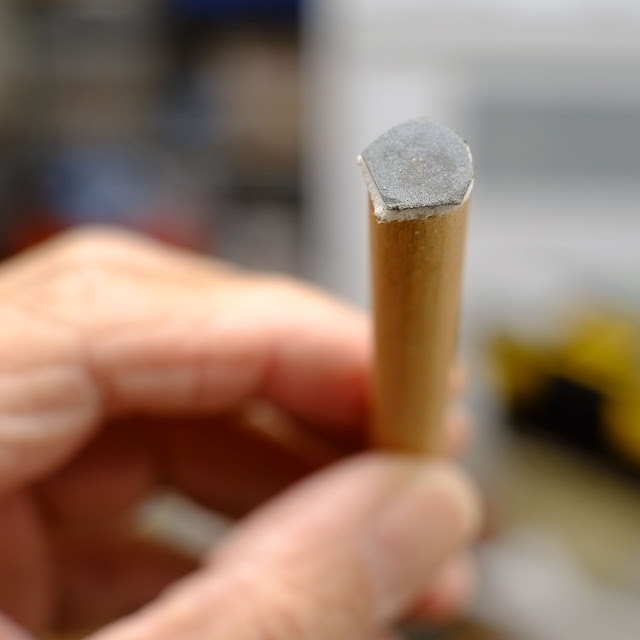
You can see from the slight depression that this improvised cleaner made full contact.

You can see the finished product here. Using my fingertips, I twisted the dowel in the battery compartment while applying downward pressure to the corroded contact. When the cleaning was finished, I used some canned compressed air to blow away any abrasive particles left in the battery chamber. The procedure successfully cleaned the battery contacts, so my SB700 is now as good as it ever was. I found that the soft nature of the adhesive tab could easily adapt to the contours of the raised dimple often found on the contacts, making my selection of the adhesive tab a win-win for everybody.

Cheap and easy, I now have a lifetime supply of battery contact cleaners for just a few bucks. Neat.


Sunday, October 18, 2020

Wide Angle Close Ups - The Opteka 15mm Macro Lens

For a compilation of the morning walk images, click here.


Stranger In A Strange Land: I had planned on postponing my take on the Opteka 15mm F 4.0 wide angle, manual focus, Nikon mount, macro lens until later in the month, but an opportunity just popped up today, and with my enthusiasm thus whipped to a fever pitch, I was compelled to write about it immediately. Unlike my past musings, this post will be a collection of loosely related,  "get to the point" paragraphs.

The Subject: I found this Walking Stick clinging to my green Recyclable bin. I don't see them that often, which is a testament to their ability to hide in plain sight. I felt this would make a interesting subject, so I grabbed my X-E2 on which I installed a Photodiox Nikon G to Fuji adapter.  I carefully moved the insect to a remaining branch on the camellia bush I cut down earlier this year, and went to work.

The Lens: The Opteka 15mm lens ($109 on Amazon) is the fraternal twin of the more expensive Venus Optics Laowa macro lens  (about $499 at B&H) with similar specifications. The former lacks the tilt/shift feature of the latter, and as such, sells for less than one-third the cost. Both offer the user a wide angle macro capability for when you want you close-up photos to include wide swaths of recognizable backgrounds.

The lens feels like its build quality was not foremost in the designer's mind. The focusing is not particularly smooth when compared to the 7artisans lenses. The big draw for the lens is the unique nature of the lens itself: It will focus to 1:1* when used with a full-frame DSLR body. Unfortunately, to achieve this reproduction ratio, the subject must almost touch the front element of the lens. The seriously restricts your lighting options. 

Lighting: I used an manually adjusted shoe-mounted speedlight with a Gary Fong Light Sphere. The head was tilted to 45 degrees to maximize the relative size of the light source. Test shots showed that the background was too dark, which is understandable, since the shoe-mounted speedlight was less than a foot away, while the background was nearly three times the distance. Think Inverse-Square Law. To remedy this, I added a second remote speedlight with an early iteration of the Gary Fong Power Grid. This concentrated the light into a "spot" that I could re-position as needed.


This shot shows the walking stick with its front legs extended forward. The photo was made from above the insect, so the background is the ivy that covers the ground in front of my home. I'm sure that if the background was less abstract and more recognizable, the visual impact of a close-focusing macro lens would have been more apparent.


Since this Walking Stick was about 4" long, I decided to switch to my favorite lens, the 25mm F 1.8 from 7artisans. Using the same aperture settings, this image shows the relationship between the focal length of the lens and the appearance of the background. The working distance between the film sensor and the subject is much shorter when using the 15mm lens, but the distance to the background is, for all intents and purposes, the same for both the 15mm and the 25mm. The shot made with the longer lens renders ivy leaves larger and less district. 

I will submit another post when I find a situation where the visual impact of this close-focusing wide angle lens is visually more interesting. For the moment, I was just pleased to have a chance to solve the lighting problems associated with using flash at very short working distances. 

*If you're wondering, a 1:1 Reproduction Ratio means that it is capable of filling a standard 35mm negative with a subject an inch long and one and a half inches wide. When used on a crop sensor body like the Fuji X cameras, the reproduction ratio is 2;1 or twice life size.