After my recent experience at Bethlehem A.D. 2021, I started to re-think what I carry in my supplementary lighting bag. In the past, the speedlights, modifiers, and mounting bits and pieces were thrown into a partition-less Tenba bag, making it necessary to rummage through a jumble of lighting stuff, searching for the bits needed to assemble a proper lighting solution. Working at night with only a miner's lamp on my head doesn't make the task an easy one.
 |
| Buy your Domke bag here. |
In years past I worked exclusively out of my big Domke F2 Bag where optional inserts with adjustable dividers made it easier to store items in an upright position. T
hen again, my approach to lighting consisted mainly of ceiling and wall bounce applications, and the only light modifier I carried was a Gary Fong Light Sphere. That second speedlight was just a backupThis catalog photo shows how I packed my equipment. With the partitions installed, you can see how easy it was to extract anything I needed.I would use the external pockets to hold two or more speedlights, while I kept the lenses and bodies in the padded interior. I still think the Domke is a great bag, but the weight of a full-blown system made me re-think my choosing Nikon DSLRs as my first-line, go to cameras. When I shifted to Fuji, much of the weight had been eliminated and my main carry bag got much smaller. But as my lighting solutions became more sophisticated, there were other carry issues to be addressed.
Initially, I relied heavily on the Nikon OEM CLS system, and employed the expensive (for the time) SB-800s and SB-900s for my primary flashes. When I started using Fujis, I tried to stay with the Fuji OEM speedlights, but found them overpriced and underpowered, and I never felt that their TTL exposure metering was consistent enough for my purposes. Eventually I used my Nikon speedlights manually and relied on their native SU-4 (optical trigger) mode when multiple speedlights were needed.

Radio Triggered Flashes: As my conversion to Fuji is pretty much complete, I started to think about how much of my old equipment could be re-purposed to a mirrorless lifestyle. The aforementioned Tenba bag has been my constant, though disorganized, companion for several years, having served as my primary Nikon camera bag in my pre-Domke years. In my re-imagination of the ultimate bag, organization of my speedlights was first in mind. I took an insert from a Think Tank Change Up camera pack, added some additional padded partitions, and voilà, my speedlights were now neatly arranged and easily accessible. And should I return to the Nikon world, the partitions will accommodate SB-800 and SB-900 speedlights without any additional adjustment.
 |
| "Flash A" with settings taped in place. |
Currently, four now-discontinued first generation Adorama / Godox Li-On Zoom speedlights replaced the Nikon SB-800s. Their primary claim to fame was that one could assemble an on-camera, radio triggered and adjusted lighting system that could be used on any platform that employed a conventional hot shoe. If you look closely, you can see that the flash "foot" has only a center contact. This allows the controller to ignore all proprietary electrical contacts, making it a pretty universal setup. I programmed the 4 flashes into four different letter groups, Each has its group letter written on a piece of tape. In addition, they have their settings taped in place so they can't be accidentally changed. Also, once a flash is used, I return it with the hot shoe down to remind me that the batteries may be partially depleted. If you look closely, you can see that I've added a 2 gig Compact Flash card and an 8 gig SD card to the slots in the insert. I chose a small CF card because I have several older DSLRs that can't use a larger card. You never know when an assignment demands the unique talents of an aging Fuji S2 Pro, my first 12 Megapixel camera.
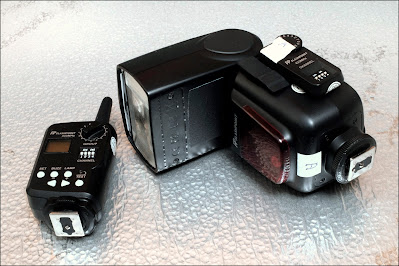
Dedicated Radio Flash Triggers: The Flash Point Radio Transmitter (to the left of the flash) will ride in the mesh compartment in the Tenba's lid. By keeping them above the other equipment, I can minimize any possible damage to their antennas. I normally carry three transmitters but load batteries in only one. I'll load a second if I need to use a second camera.
Batteries: The batteries were my next concern. Because of their density, they could potentially damage fragile electronic equipment if allowed to crash about. This battery carrier from The Container Store gives me space for some AA and AAA batteries, two lithium-ion batteries for the Flash Points, plus some other odds and ends. There's plenty of additional room for spare batteries for my Godox V1, my Fuji X-100s, and my other Fuji bodies. It also holds two spare plug-in receiver modules for the Flash Point flashes.For the moment, this little box currently holds all of the loose "heavies" that I brought with me on my last assignment, and the contents could be easily changed if the situation warrants. Spare camera batteries are usually kept in the camera bag and not the flash bag, but misfortunes arrive when it's least expected. It's comforting to know that I have spares in two different places.
So far, everything I've listed in this post has been neatly stowed away. As you can see, there's still plenty of space in the area beside the speedlight cluster and the battery box. And I still have the three outside pockets to fill.
I think I'm on to something. In my next post I'll add more goodies.


