The Editor In Chief of the newspaper I photograph for received an award from a statewide educational consortium representing the school I teach for. Here was an opportunity to make a photo of my two bosses.
The requirements for shooting events are pretty straight forward. Use flash. Choose a suitable vantage point. Set the camera to a relatively high ISO so that the flash recycle time will be brief. Say something so that the subjects will look your way. Consider your first shot your only shot.
This evening, I opted to aim my SB-800, zoomed to the most narrow beam angle (105mm), at the ceiling behind me so I'd get even front-to-back lighting. Camera was a Nikon D600 with a 24-70 2.8, ISO set to 800. The dining room's white ceilings would make an excellent bounce surface. I attached an SD-8a supplementary battery pack to the speedlight to cut my recycle time. Immediately after the shot is made, I'll usually say, "Hold it!", and make a quick check of the LCD display. If the shot looks reasonable, I'll make eye contact and say, "Thank you!" indicating that they are free to go.
As the recipients received their plaques, they "instinctively" turned to face the camera, something that public figures are used to doing. They usually give great smiles, and are patient enough to wait for the flash to go off, a simple indication that the shot was taken. Sure, one shot is really all you need, but what if it sports some minor flaw?
Now here's the spoiler alert: Plaques tend to be highly reflective metal.
 The shot to the left required a retake. Our honoree inadvertently tipped his award up slightly, creating a perfect reflection of the light bouncing off the ceiling behind me. This can be a problem with ceiling bounce because the bounced light source covers is so very large.
When I glanced at the image in the LCD display, I saw what went wrong, and said, "One more, please!" and proceeded to make a second shot. (I know how to say, "Uno Mas" too!).
 Now you can simple tell your subject that the award must be tipped forward slightly, assuming that the s/he can actually hear you, or as is the case with some of my subjects, understands English. So when words fail me, I shift to Plan B and channel my inner Marcel Marceau and demonstrate, with my hands, exactly what I want my subject to do. In this case, my subject immediately got the idea, so I made the shot and gave a "thumbs up" sign, a sign that we were finished.
So after a bit of correction, I made a second shot.Unfortunately for me, the subjects actually changed. Sure, I now had the plaque properly rendered, but my main subject's smile turned into a smirk, and I lost eye contact with the presenter on the left.I sent both of the images to my Editor in Chief and asked him to choose. Which would you have gone with: Good Facial Expression, or Well Rendered Plaque?*
I took this shot of an award recipient and his sponsoring teacher. In this case, the ambient lighting was so low I gave up on it. By shooting at a slightly lower angle, I was able to get get the ceiling lights in the background. I bounced the flash off of a wall behind me. I sent a copy to the student's school principal for anyone to use, since the the student didn't live in our service area and wouldn't be printed.
Lest We Forget: Remember that you really don't have a lot of time to make adjustments, and my making the second shot was an act of desperation. Also, if you flub it, a dining room with 300 guests will be there to witness it. And finally, like it or not, the picket fence really was the shot you were sent to get.
This photo of award recipients from a Mock Trial shows that I learned my lesson. A generally pleasing photo where I nearly got all of the "legs" properly positioned. A good shot otherwise, with everyone, save one, looking directly into the camera.
*My Editor chose the Well Rendered Plaque.
Carnaval 2015 has come and gone, and I realized that my enthusiasm changed a bit over the years. While I claim to love being in the presence of "scantily-clad women", I was a bit more introspective this time, determined to make photographs technically better than those I took in 2013. That was also the first year I checked in at the Press Center and got an official Event Press Pass. And with that came my membership in a huge, self-serving publicity machine. Photographers are encouraged to become a part of the event and share their images with the event website to give the wider public a better view of this San Francisco-style cultural event, writ large. Hey, I've been photographing Carnaval since 2008. Slam dunk. Bring it on.
What caught me by surprise was this year's overcast skies, initiating a subsequent re-thinking of my exposure solutions. I quickly realized that my usual flash fill approach was a little heavy handed when shooting under a heavy cloud cover. As it turned out, I found myself seeking out individual subjects, faces that spoke to some aspect of the event, rather than the more populated, and well choreographed, performing groups.
Flash Gone Good: Flash still has its place, even under flat lighting conditions. Overcast skies do produce shadows, usually just enough to prevent catchlights from appearing in my subject's eyes. And even though my on-camera flash produced only a tiny bit of light, its just enough to even out the exposure considerably. For these two shots (left and below), I used a 12-24 wide angle lens on a D70 body, and a neutered SB-28 speedlight connected with an SC-17 flash extension cable. In both of these shots, the flash isn't that obvious, although the tell-tale shadows under my subject's chins is the giveaway.
 One thing that I discovered: non-TTL flash automation did not work particularly well under these lighting conditions. I can't explain why this is so, but I was forced to shift to manual settings. This turned out be a wise decision, as I tend to set my flash at a lower output level. This helped the flash take more of a "back seat" during the exposure, so much so that the flash fill is barely visible.
Flash Gone Bad. If these two photos (left and below) photos are an accurate representation of Bolivian People, I want to get to know them better. The first thing that I noticed was the stuffed animal. I thought about it a moment, and realized it was a spoof on the "Guinea Pig on a Stick" street snack. In this flash shot, I held the flash high over the camera. and was rewarded with (or punished by) a shot where the nose shadow crosses my subject's lip line, a lighting no-no in portraiture. You can also see that the background is seriously underexposed, the result of having set my camera to my "blue sky background" exposure combination. Granted, the exposure difference between the foreground and the background give good separation, but the image would have a muddy appearance if it were published.
For the candid shot (above), I switched to a 70-300mm zoom which helped make the background an integral part of the composition. True, I lost some eye detail, but I doubt that a little shoe-mounted speedlight would have had any effect. But seriously, it's the background that makes the photo.
I started concentrating on individual subjects, using my long lens to get up close and personal. This gentleman was shot with my lens set to a focal length of 230mm. Making this shot at this setting would have been an impossible feat if it didn't have Vibration Reduction.
For selfies or Instagram photos, the Smart Phone has become ubiquitous, even here at Carnaval. Performers find some very creative places to put them while they're performing. Not that I was looking for them, but they'd pop up in the darnedest places.
The photo (above) was something of a save. Here, the one hand is visible and actively involved, and gives the image something of a "floor" to keep the viewer focused on the performer's face. I loved the visual explosion of reds, pinks, and oranges, and knew there was a "winner" to be had for the taking. I made about a dozen exposures, this being my second shot.

I continued to shoot, trying to keep the composition as tight as I could. I made a conscious effort to get shots where one (or both) hands are close to the face. This allowed me to pack as much visual content into the image area as possible. I would have lost a good deal of impact if I was forced to zoom out to captured some outstretched arms, so I kept trying for a tight composition. I thought I had the shot when my subject raised a whistle to her lips to punctuate the beats of the nearby drum corp. But when I checked it during post production, I realized the whistle was nowhere to be seen, and a viewer might assume she was plucking something from her mouth. Funny how important showing a tiny bit of that whistle could have been.
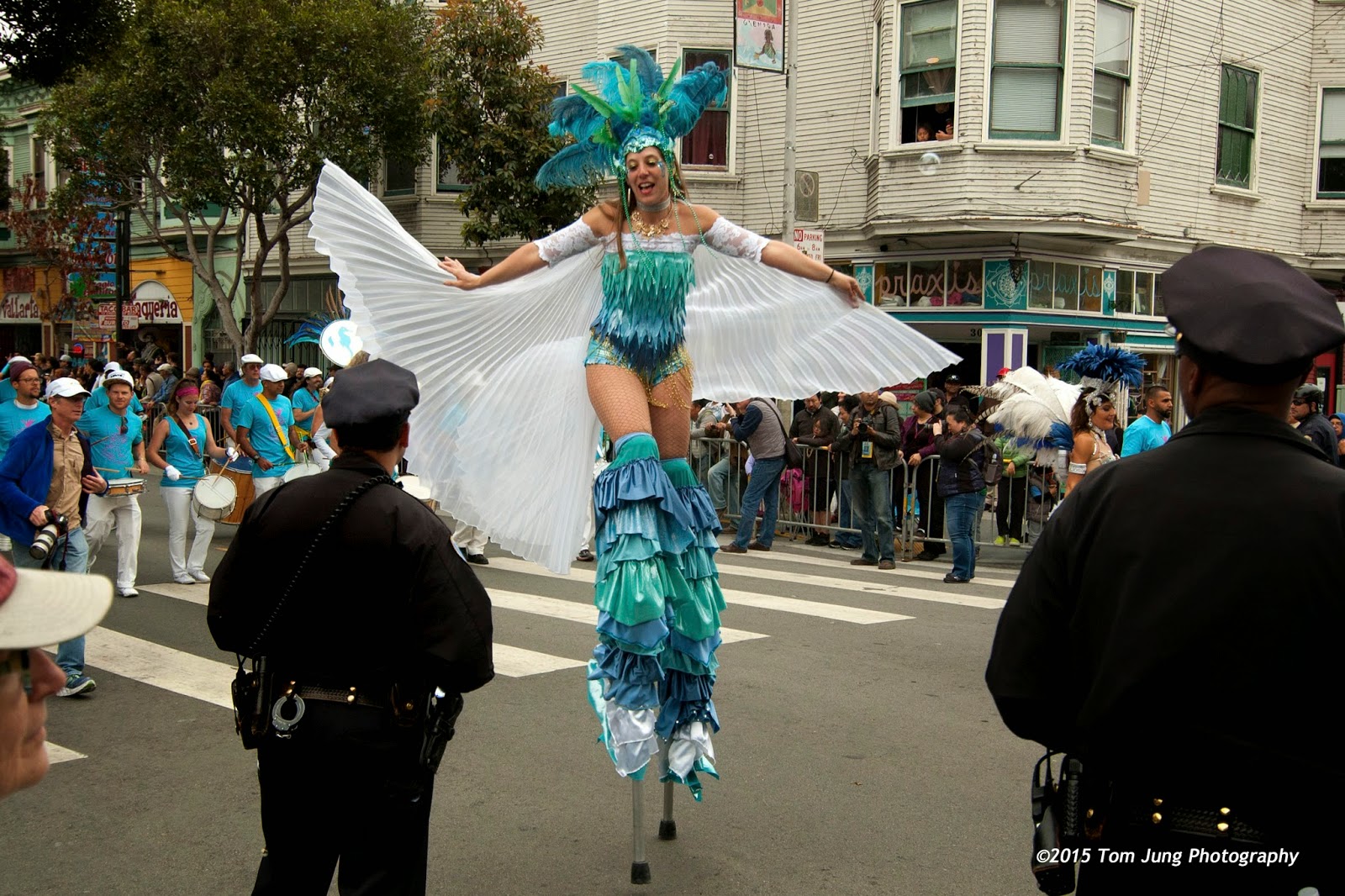
This final shot was a gimme. The reflections from their belt keepers provided enough detail to identify the two Police Officers, who essentially keep the viewer's attention on the stilt-walker in the middle of the image.
OK, I did have a good time. I'm pleased with the results. I'll be back next year. And maybe I won't bring a speedlight.


 The shot to the left required a retake. Our honoree inadvertently tipped his award up slightly, creating a perfect reflection of the light bouncing off the ceiling behind me. This can be a problem with ceiling bounce because the bounced light source covers is so very large.
 Now you can simple tell your subject that the award must be tipped forward slightly, assuming that the s/he can actually hear you, or as is the case with some of my subjects, understands English. So when words fail me, I shift to Plan B and channel my inner Marcel Marceau and demonstrate, with my hands, exactly what I want my subject to do. In this case, my subject immediately got the idea, so I made the shot and gave a "thumbs up" sign, a sign that we were finished.